Assorted Things About Ducks I Never Knew Before I Got Ducks

Hey, no photos!


1.  They stretch and yawn like cats. They also have claws(!).

2.  They can be herded.  (Unlike cats.)

3.  They grow incredibly fast.  You can see differences overnight.

4.  They instantly recognize the color green as something good (to eat).

5.  They don’t absolutely need to live on water.

6.  Not all ducks can or prefer to fly.

7.  One is definitely the loneliest number for a duck.

8.  They do almost everything in a group.*

Are you looking at what I’m looking at?


9.  It takes a while before they can quack.

10.  They really do poop a lot.

*I have now corrected my previous use in this blog of the term “bevy” for a group of ducks.  Somewhere in my early research I read that this was an appropriate term but apparently not.  😦 !  There are various names depending on whether the ducks are on land, water or in the air.  I will do my best to use them (accurately) in future entries!


Copyright 2012, Lori Fontanes

Happy First Week Birthday, Ducklings!

If only my 10-year-old liked green food as much as ducklings do.  I haven’t seen this kind of voracious consumption since the last time I squirreled away all the Thin Mints and gobbled a whole box at one go.  Not my finest hour, I mean, 15 minutes.

On Saturday, after the second vet visit, I decided to treat the girls to some lawn clippings from our unsprayed, organically fortified lawn.  All the duck experts (hereafter, ducksperts?) recommend offering fresh greens very early on.  This can be new grass, lettuce, etc. but not placed directly on the bedding where it can be trampled on and otherwise, ahem, soiled.  With all the stress over Gladys’ health issues, I had not gotten around to it until our fourth day together but, no biggie, they had had GroGel for extra nutrients and the finest non-medicated poultry crumble until then.

I went out to the newly mowed front yard and gathered up a handful of still perky greens.  Grabbing a pair of scissors, I trimmed the grass onto the surface of their drinking water, sort of like cutting chives with kitchen shears.  It took less than a second before they assaulted the lawn salad with their ducky tongues.  Four tiny ducklings made as much noise as a couple of St. Bernards slurping on a hot day.  Even Gladys scurried over, although, truth be told, she got very little of the treat.  Her bigger pen mates dominated the bowl and even leapt at my hand as the clippings fell like green manna around them.

On Sunday, a very rainy Earth Day, I repeated the green miracle and made sure my daughter, Pamela, got a good look, too.  (Alas, she did not take the hint.)  But progress was made in someone else’s health picture: Gladys.  I may be anthropomorphizing but it seemed to me that within hours of her antibiotic shot, she reacted like I do after a Z-Pak, she was a brand new duckling!  She waddled more assertively, ate and drank more effectively and held her own with her peers.  Ok, not completely like me but you get the idea…

Even on this, their first day of damp weather, the ducklings spend most of their time away from the brooder lamp.  Only Gladys sat directly in the hot spot and only then when necessary, say, after she’d gotten a little wet from taking a drink.  Otherwise, when resting, all five clump together in a motley-colored fluff ball, Gladys nearest the heat and the others in assorted arrangements.  They even end up at the far end of the pen sometimes, their mutual body heat enough to keep them happy.

Ok, everyone alternate!

I’d been cleaning up the litter daily by taking out the wettest material around the waterer and adding some here and there when needed.  Today I do a thorough removal of the bedding around the plastic grille and freshen up the rest.  The ducks go through about three small watering containers worth of water each day and this was sure to increase rapidly.  I give them more crumble at the same time but only filling the bottom part of the feeder so it will stay fresher longer.

In this weekend downtime, I review the literature and make some notes about upcoming milestones, including taking them outside and, Big Moment in Incubated Waterfowl Life, actually getting them into water.  We’re a week or so (and better weather) away from this last one.  Even though they’re ducks, they can drown if not supervised carefully at this age.  Fatigue and wet, pre-adult plumage play a role.  The plan is to get them into a small basin sometime around the third week but, even then, I’m not sure about Gladys.  Her continued tendency to flip over still worries me.  Ducks are unwieldy on land but even more unwieldy on their backs.  And watching them turn back over is a bit like watching a horse getting up from a lying down position– only much less graceful.

As I review the feeding schedule, I make a mental note that I will need to track down an organic, non-medicated crumble and think I can find it at a local pet supply that I researched in the pre-duckling days. The small bag I ordered from the website was still more than half full but it wouldn’t last forever.  Also, the brooder pen would need to be expanded this week and I must find time to finally put together that DIY outdoor holding pen that’s been sitting in a 2 X 4 pile in the garage.  The only power tool I let myself operate is a portable drill but I have no idea how to use it as a screwdriver, essential to finishing the project.  I’ve been meaning to beg someone’s assistance because the on-line videos I’ve watched don’t really help.  Since I’ve taught myself to cook from scratch, grow food, edit movies, not to mention, raise a child, I think I can handle this latest task—just can’t find 15 minutes to focus on it!

MONDAY 4/23

I may be jinxing it but two days after Gladys got her antibiotic shot, I think she may have turned the corner.  Occasionally, I come into the garage and see her flailing on her back but if so, one of three things happen: 1) she rights herself, usually after a few attempts with “recovery’ breaks between, 2) if it’s taking too long, I feel uncomfortable and help her back over—I know, I know, I probably shouldn’t interfere but there are lots of times when I’m not around so it balances out or 3) and most intriguingly, one of the other ducks, often the other Welsh Harlequin, comes over and nudges her.  This always does the trick even though I’m not sure whether it’s the force of the nudge or the embarrassment of being caught in the terribly awkward position that gives her the final push.

TUESDAY 4/24

It’s not just my imagination, Gladys is clearly better.  She’s visibly wider if not much taller and the opening on her head seems much the same, if perhaps a little less weepy.  It’s hard to tell because I’m still applying antibiotic gel twice a day so it’s always a little shiny.  All of the ducks are acting more duck-like, at least what I can see in my limited experience with ducks.  They groom themselves in a maneuver that includes turning around and ruffling their feathers near their posteriors.*  Of course, whenever Gladys attempts to do the same, she falls over.  I remain concerned that she may never be able to swim properly and now I worry that she may not being able to keep her feathers shipshape enough to become fully weather-resistant.  But, as you may have noticed, I’m a worrier and we have a way to go before that becomes a real issue.

Gladys lies down to both eat and drink.  Not sure if this is easier from a balance perspective or to possibly to reserve strength.  Occasionally the other ducks do the same but Gladys almost always does it.**  All five ducks sleep, nap and doze together.  One of their favorite spots during the day is on the opposite end from the brooding lamp.  They wedge themselves together in a formation I call the Five Duck Pile-Up.

WEDNESDAY 4/25

It’s been a week since we brought the fluff balls to this cluttered garage.  To my eye if not to anyone else’s they are obviously bigger, calmer and, if you must know, poopier.  I am refilling their baby feeder and waterer more frequently (especially the water) even though they appear to spill as much as they drink, if the adjacent drenched bedding is any indication.  Gladys does not end up on her back at any time today—or not when I’m around to notice.
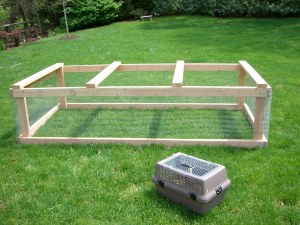
 

The new poultry pen and the cat carrier used to shuttle the ducks between garage and yard.


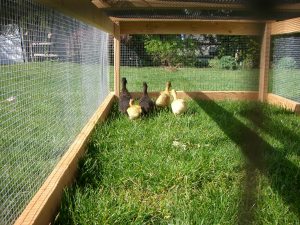
It’s a scattered sunshine kind of afternoon and the temps push up to the low 60s.  I decide that this will be the day to get the bigger ducklings outside in the temporary pen just completed the day before.  (Yes, I had to pay someone to do it.  More on the whole pen/coop story later.)   I’m excited about the going outside thing even if they aren’t—my babies! in the great outdoors!  Puff lets me pick her up without much resistance and Fannie-or-Bonnie comes along for the ride in the cat carrier,  filled with fresh litter.  Their peeps accelerate as we walk through the house and onto the back porch.  I leave the carrier in the grass and let them adjust a bit before I move them to the bigger space.  And it is an adjustment: the sun on their feathers, the light wind lifting  downy coats, the orchestra of weed whackers and lawnmowers from surrounding properties.   Ah, suburbia, thou art so unquiet most weekdays!
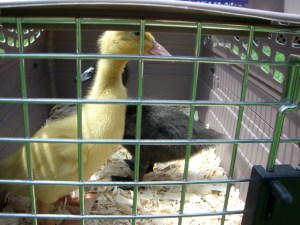
 

Puff the Buff and Fannie-or-Bonnie the Cayuga, moments before going into the pen.


I open the top of the carrier and gently lift out first the Buff Orpington, then the Cayuga.  The grass, admittedly, is a bit tall for them.  I keep it about 3” or so but it’s been a week since I mowed back here and it could have crept up to 4” or more.  I remember that ducks don’t like tall grass and for the briefest of moments, they seem unsure of what to do.  They sit plumped together, back to back, like soldiers covering each other in enemy territory.  Then the lure of all that green overcomes any temporary hesitation.  They plunge their small bills into the verdure, mouthing at the grass tops, testing, tasting, aaahhhh.

You take the right, I’ll take the left!


Since the pen does not have a permanent cover, I hover over them, the substitute hen, alert to a dog jumping a fence or a Cooper’s hawk about to dive.  They get about ten minutes in the Green New World before I pick them up again and carry them back to the boring safety of their brooding pen.  Do the other ducks notice?  Did they miss them at all?  If so, they aren’t quacking about it….

Getting to go outside was a big moment for Woman and Ducks but the most significant development isn’t anything the girls are doing but something my husband, Andrew, is.  Each night when he gets home from work, he puts down his BlackBerry, takes off his tie and goes into the garage to check on the ducklings.

Indeed, we have come a long way in one week.

Hey, can we get a lawnmower over here?


*Savvy readers will recognize this as preening—accessing the oil gland near their tail that helps keep their feathers waterproof.

**As they get older, they all lie down to eat and drink, ringed around the dispenser like spokes on a bicycle wheel.  Naturally, on the water, they would be “lying down” all the time.


Copyright 2012, Lori Fontanes
How to Raise Ducks: Recommended Reading

Gladys at two and a half weeks old. Hanging in there!
Photo by Pamela Rosenburgh


Whenever I start a new project, I buy a book (or ten.)  I also like to call people and ask them questions or go places and actually see things in 3-D, formerly known as “real life.”  Web research complements these primary and secondary sources but a good book is usually my favorite way to get really in-depth about a topic.  Short of doing it myself, as you can see.

What follows is a partial list of resources I used while trying to get my head around this whole Ducks by Mail adventure.  I’ll try to add to it as I find new material.  Enjoy!

Books:

Storey’s Guide to Raising Ducks: Breeds, Care, Health by Dave Holderread, Storey Publishing, North Adams, MA, 2011 edition.  This is the most comprehensive book I found on the topic of raising ducks and is a great place to start if you are contemplating a similar journey.

Ducks: Tending a Small-Scale Flock for Pleasure and Profit; Cherie Langlois; BowTie Press; Irvine, CA;  2008.

Ducks, Geese and Turkeys for Anyone; Victoria Roberts; Whitsett Books; Stowmarket, England; 2002.

The Resilient Gardener: Food Production and Self-Reliance in Uncertain Times; Carol Deppe; Chelsea Green Publishing; White River Junction, Vermont; 2010.

The Backyard Homestead; edited by Carleen Madigan; Storey Publishing; North Adams, MA; 2009.

Magazines:

Backyard Poultry, it’s been both inspiration and resource.  Chickens are the main course (sorry! couldn’t resist) but there are frequent articles on ducks, guineas, etc.

Mother Earth News covers a wide range of topics but they have had some fabulous pieces on raising backyard poultry.

Websites:

Ducksforbackyards.com  Really helpful, kind and funny folks who also sell chickens and geese on-line.

Duck Research Lab, Cornell University College of Veterinary Medicine

Organizations:

American Livestock Breeds Conservancy


If anyone else has more suggestions, send them along!


Copyright 2012, Lori Fontanes

Los Angeles vs. Suburban NY: Two Lists

Ten Things in Suburban NY That Keep Me Sane (Or How Lori Got Her Groove Back When She Left L.A.)

1.  Walking.  Anywhere, everywhere.  In all kinds of weather.

2.  Caring about the weather.  Knowing whether the weather matters, any given day.  Related: actually having weather.

3.  Deeply quiet nights.

4.  Not having to use an alarm clock because the birds wake me up.

5.  Living in a place where my daughter can walk down the street to a play-date by herself.

6.  Living in a place where my daughter can play without having a “date” to play at all.

7.  Living in a place where my daughter’s activities are no more than a five or ten minute drive away.

8.  Connecting to a community where everything revolves around the public school calendar.  Tapping into that connection through shared work.

9.  Not using a cell phone.  The service around here is terrible (yay!)

10.  Not having to drive on the 405 anymore.


Ten Things in Suburbia That Drive Me (A Little) Crazy*

1.  Leaf blowers.  (See note*.)

2.  Construction.  (Ditto re: note*.  Plus, I’ve been known to make a little construction noise myself from time to time.)

3.  Cars that idle in front of school for thirty minutes on a pleasant mid-fifties day.

4.  Compared to L.A., it’s hard to find good cheap eats. Except for pizza and other Italian. Good sushi is tough to come by at any price.

5.  And on that note:  many things seem to cost more and it’s not always clear you’re getting your money’s worth.

6.  Ubiquity of lawn and garden chemicals.*

7. Maybe it’s all those years in California but I find the driving on NY roads to be appalling.  Won’t say which states are on the plates but I think we all know who they are.  Smiley face.

8. Sometimes it’s a little too “Mad Men” out here.

9. Humidity.  Sigh.

10. Mosquitoes!


*Granted, some of these things can be found in both places.


Copyright 2012, Lori Fontanes

The Drama of a Special Needs Duck

On Saturday, Day Four With Ducks, I sleep in recklessly until 7:20 but need to start the coffee before peeking at the girls.  I take note that my cat isn’t too crazy about the new “check the ducks before checking the cat food” routine.  Then, before opening the door, I brace for the possibility that Gladys might not have made it.  It’s a moment’s hesitation but I can’t help myself.

As it turns out, all five ducklings are clustered together—alive! —a little ways off from the brooder lamp.  This means that either it didn’t get too cold and/or they’re growing fast enough and don’t need the heat as much.  (On previous mornings they were always under the lamp first thing.)  Gladys is huddled at the edge of the group, closest to the heat but with them, not apart from them.  I let out my breath.

After caffeinating, I go back and clean up the waterer and feeder.  The new plastic grille seems to be doing the job of keeping the bedding drier.  Everyone but Gladys comes and goes between the dispensers easily and freely.  Since she seems to have trouble regardless of where I placed them, it felt fairer to position them where it would be cleanest for all.  But my heart gave a twinge as I watched her continue to struggle.

In truth, it all feels very Darwinian.  Charlie needed the Galapagos but the garage is enough for me.  It’s all writ large inside this pen—the strong ones get the crumble, the weak one gets less.  And meanwhile, here I am, working hard for the survival of the not-so-fit.  Is that good/bad/ok?  For her or for us?  I can’t figure out how far to take it yet; I think I have to try.

Today, Gladys’ peers don’t seem to single her out for nips as much as before.  They’re pretty much equal opportunity nippers if one of the others is in the way. But since they move much faster and are so much bigger, it’s Gladys who is often the roadblock. Worse yet, she periodically stumbles and ends up on her back.  With ducks, it’s hard work to flip over again once they’re supine.  At first, I would pick her up myself but yesterday I attempted a “wait and see” approach.  Kind of like what you might do if your baby started crying in the middle of the night, seeing if she can calm herself before you rush in to pick her up.  (Full disclosure: I wasn’t really great at that either.)

After each of these exhausting struggles, Gladys hustles back to the brooder to regain strength before attempting further forays.  It’s tough to watch.  She clearly knows how to eat and drink but she gets less because it’s so difficult.  And I haven’t noticed any improvement in the opening on her head although I am dutifully applying the gel twice a day.  I think I’ll call the vet again to check in.  After feeding my cat, of course.

#####

As the morning passes, Gladys goes from struggling to barely moving from the heat lamp.  She even seems to have trouble keeping her eyes open—she is very weak, not eating but also, for the first time, not drinking.  This won’t work.  The others go their ducky way, scurrying in a cheery clump from water to food.  They ignore Gladys but Puff, in particular, likes to keep one beady eye on me.  With her height, she is the de facto sentry and unless I make a sudden movement, she doesn’t flinch like the smaller Cayuga ducks do.  Leadership material.  I have a passing thought, quickly suppressed, about how easy they are and was I missing the joy of seeing them flourish as I wallow in my anxiety about their flawed sister.  Maybe I can see their perfection better because of her?

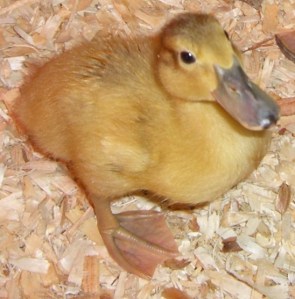
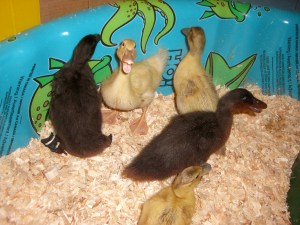
They do appear exemplars of duckhood–healthy, hardy and growing.  Fast.  The website folks warned me they would grow fast but I didn’t expect to see that growth practically happening in front of my eyes!  In just two days, the other Welsh Harlequin has caught up with the Orpington Buff previously the biggest duckling, per her class (the Buff and the Cayuga are Mediumweight and the Welsh Harlequin is Light.)  Of the Cayugas, one is slightly smaller than the other which is the only way we can tell them apart.  Their fluffy juvenile feathers, adorable webbed feet and little bills are glossy black.  The Welsh Harlequins are yellow streaked with black and the Buff a lovely soft yellow.  My daughter, Pamela, says she can’t see the growth spurt but we both see clearly that Gladys’ size has not really changed in four days.

#####

Pamela is on a playdate when I call the vet. I blurt out that I’m worried–this snippet of a duck doesn’t appear to be drinking and is just sitting under the brooder lamp, eyes closed.  To my mind she is like all the dying birds I have ever brought home, fallen from trees, abandoned or stunned by circumstance.  What should I do? I ask, distraught.  I don’t want her to suffer.  And what if she does die?  Are we allowed to bury her?  Do I bring her to you?  I am told that Dr. Y, the exotic animal specialist and the vet originally recommended by the other duck owner, will call me to discuss.

It’s not much later but by the time he calls, I am mentally prepared that we will have to put Gladys to sleep.  But as it turns out, Dr. Y’s take is a little different.  He says there are three things we can do—put her to sleep, do nothing and see what happens or, give her an antibiotic injection to help her fight off a probable infection from the opening in her head.  We discuss her daily struggles and the pro/con of prolonging what seems to be tough but not physically painful.  I decide to bring her in and then decide.

When I quietly open the garage door, anticipating the crumpled form under the light, she’s not there.  She’s with the others, galumphing between water and food, holding her sorry own.  It’s as if she heard the discussions of her fate.  I wait for her to get a little more water and then I scoop her into the carrier.

#####

“Her crop is full of food,” Dr. Y says, as soon as he picks her up. This seems to be a deciding factor. I tell him of the change in her behavior right before bringing her over.  Where is the sickly little thing I described on the phone?  She is peeping away in his hands.  He says that he got a look at her on Thursday so he must be able to see her progress (or lack thereof).  He’s still optimistic about her chances and my spirits begin to lift.

And then he says, something along the lines of, “she may never be normal.”  Pretty much what the other doc said, pretty much what I had concluded myself.  He looks me in the eye and asks, very directly, if I can handle that.  I meet his gaze and say with as much confidence as I can muster, yes, I hope so.  I then blather on about how we bought this house with a big backyard and wanted to have the ducks run around, natural pesticide/herbicide, organic lawn, blah, blah, blah and pets, of course, blogging, and….I run out of steam.  Jeez Louise.  I could hardly sound more stupid or shallow.  Gladys is not just a blog item.  She is named. She is ours.

The doctor ignores my pretentiousness and merely says, I’ll give her the antibiotic shot.  Come back in a week.  He doesn’t add, if she makes it.  He just says, come back.  I like that he said it like that.

As I walk to the counter to pay, all at once I stop worrying whether I’m going to find her on her back some morning.  I stop worrying if she is struggling too hard (she’s eating, he said she’s eating).  I want this tiny awkward puffball to make it, damn the vet bill. (Andrew, forget you read that.)  Daydreaming, I miss the moment when Gladys flips over in the cage and can’t turn back over.  She whistle-peeps her distress, I say oops and try to reorient her as I juggle wallet and pen.

And then we head home, both of us.


Copyright 2012, Lori Fontanes

Make Way for Andrew

As you may recall from the beginning of the saga, my husband, Andrew, has been deeply skeptical of this whole venture.  He’s a lifelong cat lover but otherwise not really into animals, neither furry nor feathered.  So my whole “let’s convert this place to a nature center project” is something he tolerates rather than promotes.  He does enjoy the garden fresh cooking (excuse me, hon, while I trim some tarragon, la di dah) but he doesn’t really have any experience, or interest, in dirt.  His one attempt to use my new push mower last summer ended in disaster but that wasn’t his fault, really.  I put it together out of a box, had some issues with the bolts…whole ’nother story.

Andrew is a screens man and I don’t mean the kind that keep out mosquitoes.  He prefers to relax in front of his not-too-big TV, on the laptop or, if pressed, on the micro-screen of his BlackBerry, playing micro-poker (for micro-stakes, I guess.)  To chill out, I prefer to wield my favorite dandelion weeder * or to push around the aforementioned hinky mower or to merely sit on my suburban stoop and watch things.  I guess it’s hard to get the Philly out of a gal.

All of which means he didn’t growl too much when we first laid out the D-Day plan but it’s also fair to say I’d been kind of anxious about this initial meeting of Ducks and Spouse.  As it happened, he managed (created a reason?) to be out of town the week we were expecting the hatchlings.  In the end, it worked out easier for me–one less mouth to feed.  And that’s no small thing now that I would have three humans, two cats and six ducks to consider!

Andrew rolled in after midnight on Day Two and apparently abided by my email request to “leave the ducks alone.”  Now, the next morning, I try to control my excitement about the introduction but end up chattering on about some of the challenges while attempting to give the impression that everything’s hunky dory.  He’s deep into his pre-work departure routine—check email, check cable business news, put on shoes—but agrees to take a peek at the peepsters on his way out.  I had already checked on the girls while he was getting ready and had left them merrily drinking and eating in the pen.  I lead him into the garage and over to the enclosure, ta daaa!  And there is Gladys flat on her back, flailing under the brooder lamp.  The other ducklings are huddled together, keeping an aloof distance.  It’s absolutely pathetic and as I lean over to help her right herself, Andrew walks away.

“Don’t spend too much,” he says, and then leaves for the train.

#####

Of course, I’m crushed.  Luckily, the daily AM panic of getting the cats fed and watered, breakfast made, and Pamela up, fed and off to school (yes, in that order) doesn’t allow me the luxury of disappointment.  And, in a reverse of the car that rattles only when the mechanic is not around, Gladys is immediately better when everyone else leaves.  She feeds herself easily and sleeps peaceably with the rest of the bunch as they settle in for their post-meal nap.  Guess it’s safe to say she gets a slow start in the morning.

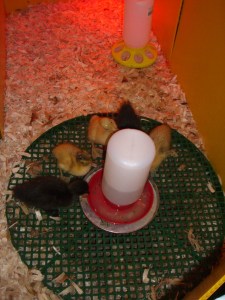
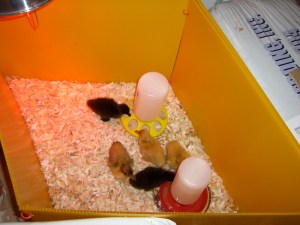
So while the babies sleep, time for some avian housekeeping.  It’s only three days in but already I can see the wisdom of placing the watering bowls on some kind of platform, to cut down (a tad) on the sloppiness factor.  (It’s not the ducks’ fault.  They’re waterfowl, not puppies!  Although, come to think of it, puppies are pretty messy, too.)  I enlarge the cardboard walls of the pen to the maximum, trying not to think too hard about where we go from here, size wise.   This gives me just enough room to add the plastic grille from Premier 1.  (I bought two–one for the feeder, to use outside– but at this point I just use both with the waterer.  I swap out the dirty one for the backup clean one and then alternate.)

New platform

The hole in the middle is too large for the smaller watering container not to fall through so I continue to use the lid of a cookie tin as a base.  The instant next problem is that the height of the grille is about 2 inches and although the other ducklings have no issue getting to the water, Gladys probably will.  The solution?  Create a slope around the edge with extra bedding.  In a couple of minutes, I see that this works well.

But it raises the question of accommodation.  Thorny.  Queasy-making.  As a newbie hobbyist, not from farmer stock (my mother’s own adventures with chickens, sheep and guinea hens notwithstanding), I have a tendency to over-analyze what surely must be automatic to those with more experience. So….today’s Big Questions:

  • How much should I coddle Gladys?
  • How much should I let nature take its course?
  • How much should I give preference to Gladys’ needs over her pen-mates?

Jeez, can I not lapse into philosophy while mucking out the pine shavings?  What a poultry poseur!  If I don’t feed them the right crumble, they’ll never get into a good flock!   I stop musing and keep mucking.

#####

And, that night, when Andrew comes home, he asks first about Gladys.

* A shout-out here for Grandpa’s Weeder, a nifty device that you stab into the heart of the dandelion (take that!), step on the foot pedal, twist and yank.  Totally easy once you get the hang of it.


Copyright 2012, Lori Fontanes

Gladys Goes to the Vet

Even through a fire door, a cat can hear things.  Especially things that go peep.  When I surprised our tortoiseshell Lulu hovering by that food-free area, I knew the hatchlings had made it through the night.  I had been totally prepared to act like a new mom, getting up periodically to check on the babies.  Then I surprised myself by sleeping straight through.  Guess I was more confident in my brooding area prep than I thought or maybe I was plain old fried.

Tugging open the door, I smiled in relief as the first duckling to come into view proved to be the hapless Gladys.  She staggered around under the brooder lamp but she was moving, in fact, they were all moving, the rest venturing easily between feeder and waterer– still upright with some water in its base.  As I watched, the others retreated back to the hot spot under the lamp and then Gladys on her own ambled over to the waterer and drank by herself.  She didn’t take any crumble but I was happy to see her still managing to hydrate on her own.  My sleep-refreshed eyes, however, saw that her poor head looked even worse this morning.  I braced myself for the upcoming vet visit.

#####

“Make way for duckling!” I announce, shamelessly, as I sauntered into the lobby with Gladys in a plastic cat carrier.  The joke fell rather flat, I have to admit, as no one could actually see the purported duckling plus the others had their own animal woes with which to contend.  I slunk over to the sunniest spot I could find and tried to keep the hatchling as quiet and warm as possible.  Mentally berating myself for neglecting to grab a towel to cover the cage (no way it was 95 degrees in here), I decided I would have to be her substitute brooder, pro-tem.  This meant sticking my fingers through the cage and when that didn’t work, opening the top and letting her lean against the palm of my hand, instead of the fluffy flanks of her peers.  Periodically she would run around like a crazy duck, emitting her distinctive whistle-peep distress call.  But, alas, none of the other ducklings came running….

Throughout the wait, I kept up what I hoped was a suitably soothing commentary (“hang in there, little one, you’re going to be fine”) and the like.  Have no idea whether that helped or irritated her; it certainly helped me!  The mostly dog owners present asked reasonable questions to bide the time.  Did you find her in the park?  Does she have a broken wing?  Did you rescue her?  And so I quickly sketched the We Bought Six—No Five—Ducks on the Internet story.  As dachshunds, not ducks, are the lower Westchester norm, it’s fair to say that Gladys drew a certain amount of attention.

One of the receptionists came over to take down my answers on the registration form so I could continue to calm the frantic duckling rather than wield a pen.  It was in this moment, of course, that Gladys truly became Gladys.  Up to this point, even though I had dubbed her that, we had put off officially naming any of hatchlings because of the confusion over how many birds and what kinds we eventually would have.  It was a kind of naming limbo and this was our first step out of that uncertainty.  I can’t remember the actual order and substance of the questions but it went something like this:

“What is she?”  A Welsh Harlequin duck.  (whistle)

“How old is she?”  Three days.  She hatched on Monday.  (peep peep)

“What’s her name?”  Gladys.  Her name is Gladys.  (whistle PEEP!)

And that was that.*

#####

The Duck Expert’s colleague, call her Dr. X, confirmed some of what I suspected and gave me a best case/worst case scenario.  A. Gladys could just be developing slowly and she may get better on her own.  Or B., she may seem to get better and then you find her dead.  Aieeeeeee.  The opening in her scalp did not appear to be oozing brain fluid (nice) but I would need to apply antiseptic gel there twice a day to help improve healing.  (OK, I can do that.)  The doctor agreed that the erratic motor skills might indicate some kind of neurological issue but there was a possibility she might “grow out of it.”  It was too early to tell.  She may also never be a completely normal duck.

Big sigh.

As Dr. X and I watched, the assisting technician made a nest out of his hands and Gladys finally settled down, totally tuckered out.  I tried to take in all the instructions as I considered the impact on Pamela of a duckling sudden death, how to manage a sick duck if we had to go out of town and other new responsibilities.  (Keep her separate from the others if they bother her.  Weigh her every day.  Weigh the others.  Let us know how she does, either way.  Good luck.)

Or she might grow out of it. 

In the lobby, everyone couldn’t be nicer.  Everyone was rooting for her.  Everyone wished us well.  All you have to do in this world is speak nicely and carry a cute duckling.

Please grow out of it, Gladys.


* To further seal the deal, Gladys got her first email from on April 21st, 2012.  A Happy Birthday animated cartoon from the vet.  Really.


Copyright 2012, Lori Fontanes

On the Cuteness of Ducklings: Reliving Day One

I’m zonked.  We only got back from Easter vacation two days before the ducklings arrived so now I’m not only jet-lagged, I’m duck-lagged.  More caffeine and then back to the garage to monitor the hatchlings.  The warnings of poultry experts rattle around in my sluggish brain.  They need water but not too much, being waterlogged can be as bad as being dehydrated.  You may have to check on them every 30 minutes if they seem weak. Brooder lamps can cause fires.  Drafts can be deadly!

Okaaaay.

Gladys is clearly annoying her peers.  They all have the cute awkwardness of baby animals but Gladys exceeds in the haplessness category.  She keeps trying to lean up against the others (as they must have done in the shipping box) but in this larger landscape, they resist being used as feathered heat lamps.  Her big sisters have also gotten the idea of water—wet stuff, good—and I no longer have to show them how to find the waterer or what to do when they get there.  But Gladys follows them to the bowl and just plops down.

I pick her up as carefully as I can and gently press her bill into the rim of the water bowl.  She resists only slightly and then, wham, back goes her head and she swallows.  Of course, the others give her very little quarter.  She can’t quite manage to keep her drinking slot so while she waits her turn, I place her under the brooder lamp to dry off.

It’s small, but it’s progress.  Back into the house and this time, I call our fabulous veterinary hospital, the people who take care of our two (former) rescue (now) incredibly pampered cats.  As it happens, I had just been at the vet the day before to pick up the aforementioned Frankie and Lulu who were boarded while we were on our trip.  In the back of my mind, I had already been mulling over where I could take our ducks if they got sick or injured…although I thought it would be some far-off future, not an immediate concern.  Ha, best laid plans!

Very weirdly, as I’m standing there waiting for the cats to come out and harass me about leaving them at the vet again, I decide to ask the receptionist whether they had anyone who can handle ducks.  Well, she replies, we do and believe it or not, someone is here right now with a duck.  Really?  I turn to see a guy walk into the lobby with a huge white Pekin (I think) wrapped in a towel, patiently looking around while his caretaker chats with the vet.  I give them a few moments before I gush—oh, you have a duck!  We’re getting ducklings tomorrow!  The Man with the Duck needs no prompting to talk about his own splendid animal.  Soon we’re chit-chatting away about the pleasures of duck ownership and he tells me that his doc is ab-fab in the poultry department.  (I’m paraphrasing.)  I make a mental note to make sure I ask for this vet when on some super distant day I might need him.

Wednesday, April 18th turns out to be that day.  Unfortunately, Dr. Y as I’ll call him, is not in and he can’t see Gladys tomorrow either as he’s fully booked in surgery.  I set up an appointment with another of the doctors in the practice but leave word for Dr. Y to please call me anyway.  I’m pretty sure Gladys is stable if she’s drinking water and sort of lapping up GroGel but I am going to be nervous all night.  The website folks tell me to give it 48 hours so I cross fingers (and toes.)  They also remind me that the ducklings can be offered food right away as long as they have water at the same time.  I hang up and speed off to fill up a feeder with poultry crumble.  Within moments, I am thrilled to see the hardier ducks going at it with gusto.  Gladys, on her own developmental schedule, doesn’t even try but she achieves her own first– drinking water without my help.

Later I share both these milestones with Pamela as we walk home from school.  A couple of her friends, eager to meet our new household members, tag along.  I lay down the rules:  No touching, soft voices, no sudden movements.  The girls ooh and aah over the fluffy babies—impossible not to, I swear!—and they giggle over Gladys’ gymnastics.  I gently explain that the little duckling wasn’t doing these things on purpose.  Surprised, they respond sympathetically and just like that Gladys adds another two humans to her list of well-wishers.*

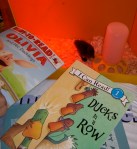
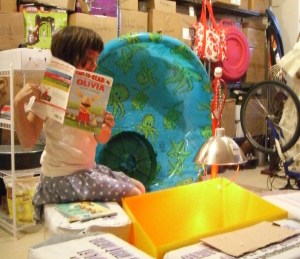
That night before bed, Pamela asks to have some private time with the two-day-olds.  Since the original idea was to give her responsibility for the birds anyway, I agree with only the slightest hesitation.  PJ goes upstairs and comes back with a stack of picture books.**  After cleaning up the excess sogginess in the pen, I snap a few pics and retreat to the doorway.

And then the very tired hatchlings snuggled together in the cozy bedding as Pamela read them ducky stories until she, too, was finally ready to go to sleep.


*It’s been suggested that Gladys needs her own Facebook page but I’m not quite ready to go there….

** Suggested bedtime reading per Pamela: Ducks in a Row, Olivia and her Ducklings and The Story About Ping.  You probably have your own suggestions.  Share them!


Copyright 2012, Lori Fontanes

Mixed Blessings Come in Small Packages

Gladys’ first day in New York wasn’t going swimmingly.  As the other hatchlings settled down to a semi-nap, she struggled with everything.  She drank if I helped her, she ran to the GroGel but then sat in it, she kept throwing herself against any available surface, including her not-too-receptive fellows, and I began to wonder about that “nip” on her head.  In the patchy light of the garage, I couldn’t see well enough to figure out exactly what the deal was.  I knew, however, that she needed to master the knack of dipping her bill in the water and putting her head back, indicating that she was, indeed, swallowing.  The crumbles could wait.  If she didn’t have food she wouldn’t thrive but if she didn’t have water, she would die.

As a part of my “convert the conventional lawn to organic homestead” program, I had hired a sympathetic landscaper to help me wrestle the existing collection of rhododendrons and roses into something more edible and eco-logical.  She and her team had started work just before D-Day and were at the house as I fussed and phoned, looking for answers to Gladys’ woes.  The support materials warn new owners to remove the ID bands from their ducklings’ legs as soon as possible after arrival.  As our littlest hatchling stumbled around the pen, I began to worry that maybe the band itself was bothering her.  So I very gingerly picked her up again and attempted to remove it.  Easier to diaper a baby in the back of a Greyhound on a bumpy stretch of I-95!  You have to pry open this bit of plasticized wire that doesn’t want to stay open as a wriggling bird objects peepily to the treatment—not easy for one person, at least not this person.

Very good-naturedly, my landscape designer (not normally in her job description!) soothed the frantic duckling and I finally managed to pry off the leg band.  Then I got my first clear look at the top of Gladys’ head.  Not good.  To my layperson’s eye, it looked like there was a split in her scalp, not bloody, but sticky wet.  It didn’t look like an injury; it looked like she might have been hatched that way.  I realized immediately that this probably wasn’t only stress—her brain itself might be dysfunctional.

I trudged back to the phone and called the website where I had ordered the ducks (only my 3rd call that day!) and reported these new details.  We had already told them about the missing duck and now we had much glummer news.  Although www.ducksforbackyards.com provides a 48-hour guarantee, I was not trying to cash in.  As the kind young woman listened to my story, I realized that I just wanted someone to help me process my own sadness.  I scarcely knew these ducks but already they were no longer anonymous cute animals on a web video.  They were ours.

And then I also knew I had to tell Pamela at least part of the story when she came home.  My fourth-grader had tripped off to school, excited about telling her friends: the ducklings are here, the ducklings are here!  But now it looked like our happiness had been slightly downsized.  We went from expecting six ducks to getting five and quite possibly fewer.  We had prayed the ducks would get to us alive; we hadn’t prayed they would all be whole.  By some oversight in my elaborate planning, I had not envisioned this possibility.  If the little one doesn’t make it, should we order more?  I wanted all the ducks to be about the same age and they only ship on Mondays so we have two days to decide, is that enough?  What if she dies and Pamela finds her?  What will the other ducklings do?  If we order more (the minimum per order is two ducks) and she survives—do we really have room for seven ducks?!!!

Gladys often needed the warmth of the brooder lamp more than her peers.


Copyright 2012, Lori Fontanes

How to Unpack a Box of Ducks, Continued

You would think after months of reading everything I could get my eyeballs on, I could figure out how to manage these first moments.  Maybe with my 10-year-old recording everything I had a touch of stage fright.  But the reality is, you just gotta jump in.  (Or they will.)  The four hardy ducklings were more than ready to escape and the fifth scaredy duck (dubbed Gladys) flailed so much, she almost fell out of my hand into the brooder.  When you think about, who can blame them?  We complain about flying coach but that’s plush compared to being stuffed in a box with a bunch of strangers and a heating pad.  Ok, maybe  not so different.

All the books tell you to gently place duck in one palm and cover with the other, speaking softly and moving slowly.  Right.  What we did was make it up as we went along, speaking as softly as we could, semi-frantically containing the fluff balls and trying to guide them toward their first sips of water (“Water is the most important nutrient.  Dip their bills in and make sure they tip their heads back.”)

This is how it actually went:

Hey, ducks, water.  The most important nutrient.  No, no, not straw!  Don’t eat that!  What the…leave her alone!  No, don’t SIT in the water.  Give her some room….Pamela, which ones had water?  That one?  Did the other black one get some?  Ok, let’s try this again.

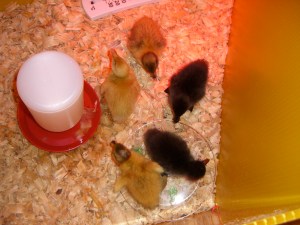
I left PJ with her new pets while I attempted to mix up a portion of GroGel Plus B suitable for 5 ducklings.* They went for the green-colored substance with nature-engineered glee.  It supplies hyper-hydration and key nutrients but isn’t necessary after a couple of days or so.  These hatchlings were extremely lively so I wasn’t particularly worried about their imminent demise but I thought a little vitamin chaser couldn’t hurt.  Later on, in one of my (many) calls to the website where I ordered the ducks, www.ducksforbackyards.com, the very nice Texans reminded me that you can offer the hatchlings non-medicated starter crumble right away, as long as they have water.  So I set up that feeder in a separate corner of the brooding pen.  At first, the hatchlings continued to poke at their bedding material thinking/hoping it was food.  They poked at the yellow enclosure walls.  They poked at each other.  They poked at me (I periodically shielded Gladys in my hand) and they particularly liked to stab at my shiny wedding rings like manic magpies, as it were.

We had started the adventure with the brooding pen in a diamond shape, the waterer in a corner farthest from the electric light.  Later that morning when I first placed the feeder, it went into a dri(er) spot away from the waterer but not under the light.  You are warned by all that ducks are “messy creatures” but that vastly underestimates their capacity for spills and other housekeeping mayhem.  I only used the GroGel the first day but in the brief moments it lived in the pen, they walked in it, sat in it,  even attempted to skate it in.  As amusing as this was, ducks don’t do well on slippery surfaces so I monitored them carefully when it was around.  (Alternately, I could have found a smaller container—say, a jar lid but I didn’t have a clean, empty one available, only this plastic picnic plate.  Next time, if there is one, I will know better.)

Really getting into their food--in this case, GroGel supplement. From left: Gladys and Fannie


There had also been advice about placing waterers and feeders on wire or plastic grid surfaces.  I ordered a few pre-built ones from Premier 1 Supplies but these were so big, they didn’t fit in the brooding pen the first day.  The working plan was to add one when I next enlarged the pen, which might end up being sooner than had I first thought.

Meanwhile, I had smaller issues to deal with:  Gladys.


*Note to reader: the little packet of GroGel gives instructions regarding the immersion of said packet into 100 ml of water.  Do not, I repeat, do not attempt to do this unless you are feeding 100 baby chicks, 200 baby pheasants or 400 baby quail.  If you plan to feed a more moderate amount of birdage, do it this way: add water to a teaspoonful of dry mixture until it resembles a cross between Jello and tapioca pudding.  (If tapioca were green.)  This website has a nice photo to illustrate.


Copyright 2012, Lori Fontanes
April 18, 2012: D-Day (Duckling Day) Arrives!

The call came in around 7:30 AM.  The post office wasn’t even open yet so I didn’t think it would be The Call.  Pamela picked it up– “Private Number.”  I almost didn’t answer.  But it was the post office, slightly anxious to get those live animals off their hands, no doubt.  Oh Lordy, the ducklings are here, the ducklings are here!  Good news: since PJ hadn’t left for school yet, she could drive over with me.  Bad news: the hour before school starts is easily the most complicated hour of the day.  What the heck—the ducklings are here, the ducklings are here!

We inched through small town traffic, my fingers tapping on the steering wheel as high schoolers slouched toward class—out of our way, we’ve got baby ducks waiting!   Finally, we pulled up to the main post office and actually got a parking spot right next to the loading dock.  (So that’s how early a bird has to get up to nab a spot!) Our regular mail carrier came out to personally deliver an unexpectedly small cardboard box, covered with holes and full of peeps.  There were wide grins all around as Pamela gently took ownership.

On the way back, we blasted the heater in the car, realizing belatedly that we had pre-heated the brooding area but not the vehicle delivering them to it!  Soon we were stifling but it was worth it to keep the chill off the two-day-old hatchlings.  PJ tried to peer through the cardboard perforations, attempting to identify the occupants.  Each breed or perhaps even each bird had a slightly different peeping sound.  The box appeared to be filled with life and we (literally) prayed (to St. Francis) that there would be no casualties from the two-day trip.  It would be a bit of a bummer to find a dead bird after all this…..

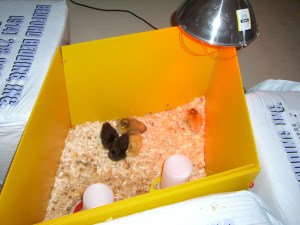
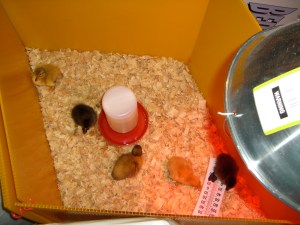
Inside the garage, the brooder set-up glowed and a thermometer verified its 95 degree readiness.  It had taken some close monitoring to keep the area under the lamp within the recommended 90-95 degree range.  Our wacky weather had gone from 40 something up to 84 degrees and down again over the last two weeks.  At least it wasn’t snowing…or at least not today!

As Pamela handled the camera, I snipped the plastic straps and delicately lifted off the lid.  We held our breaths and counted…1, 2, 3, 4, 5…only five?  There were no dead ducks (thank Francis!) but we appeared to be short one and the fifth one, even at first glance, looked a bit off.  This last duck, I decided to call her Gladys, moved differently that the other hatchlings.  Her wings stuck out at odd angles and it looked like something had nipped her head.  I’m not a vet and I don’t play one on YouTube but I knew instantly that this little duckling had some serious issues.  I could hear my husband’s voice already—how much is this gonna cost? Duck, $8.95, everything else, priceless!


First set-up, water only. Added feeder later that first morning.

Copyright 2012, Lori Fontanes

Which Came First, The Cook or The Hobby Farmer?

In 2007, when I first got passionate about environmental influences on health and well-being, call it, Lori’s Freak Over All the Crap Out There, I also started cooking.  They go hand-in-hand.  Or fork-in-hand, as the case may be.

As Jean-Anthelme Brillat-Savarin said, back in the day, “tell me what you eat and I will tell you what you are.”   If that’s true, then for most of the 90’s I was a mix of Peanut Butter Cap’n Crunch, cup o’ ramen and sugar-free Eskimo Pie.  How did I go from processed princess to someone who knew exactly what to do with kale (and don’t say, throw it out….) Well, it took a little time.  About 2-3 years depending on how you measure the culinary missteps but, heck, no one died!

In my self-made Julia Child-meets-Martha period, I learned how to:

  •  Identify most vegetables at a farmers market.  Bok choy used to panic me, now I look forward to it, oven-roasted with sesame oil and a little soy sauce on a bed of Calrose rice.
  •  Cook almost anything with the simplest ingredients.  If you can find more than a couple of ways to use that exotic spice collection you bought on sale at Costco, knock yourself out!  (I know mine went stale before I could use it up.)
  •  Buy vegetables and fruits when they are cheapest, freshest and most available.  AKA eat seasonally.  I remember the days when I timidly went up to the produce guy at my grocer and asked, what tastes good this week?  Soon I learned that apples are freshest in the fall, asparagus in the spring, berries in the summer and winter squash, well, even I could figure that one out.
  •  Buy or grow the best ingredients you can. It’s the secret to making the tastiest, healthiest meals.

Hmm, buy or grow….let’s try grow (but let’s try small.)  I started by growing my own herbs because every time I wanted fresh cilantro or basil, I either didn’t have some or it had already gone slimy in the fridge.  Dried spices work fine for certain recipes but more and more I appreciated the difference a flourish of chopped greens made.  My first attempts were with small pots but they were tough to keep watered properly.  Many dead plants later, I moved to a single raised planter on the back porch and voila!  Lettuce (easier than you might think) and peas (none at all and then a ton) quickly followed.  This year I’m jumping into tomatoes, potatoes, scallions, shallots, eggplant and cucumber.  Upping the ante will undoubtedly end with some disasters but, as they say in show biz, first-time farmer goes all out, comedy ensues!


Copyright 2012, Lori Fontanes
Suburban Lawn into Backyard Homestead: Education of a Green Gardener

Hard to pinpoint exactly when it began but at some point I became excited by the idea of putting my soil to better use than hosting a green moat.  It might have started with those little yellow flags that pop-up on Westchester County lawns all through the growing season.  In case you don’t have these in your state, the flags are warnings that garden services are legally required to post when they treat properties with certain chemicals.  They are supposed to give you, the co-user of the local environment, notice “advising of the pesticide application and when it occurred, and not to enter the treated area for 24 hours.”

Huh.  That’s odd, the newbie New Yorker, said to herself.  What happens if the stuff blows in the wind?  What if my dog runs on your lawn by mistake?  Does it really go away after 24 hours?  What if I have my windows open during application?  What if my child is playing next door when they are spraying?  Why don’t they warn you in advance so you can prepare?  What happens if it rains–does it run-off onto other people’s properties?  What the duck is actually in that stuff anyway???*  In other words, the warning flag provided more questions than information.

As a mom, I am super-sensitive, ok, I am hyper-sensitive to the dangers of man-made toxins.  Since Pamela was born, there has been a growing drumbeat of data supporting the idea that environmental factors can play a role in many diseases.**  Moreover, it is clear to me that all these chemicals we are so merrily absorbing into our bodies—both deliberately and inadvertently—are a potential devil’s brew.  The fact that we are focusing on one alarming chemical at a time (lead, pthalates, BPA) when there are tens of thousands of compounds introduced since World War II makes it feel like we will never get our hands around the problem if we continue in this piecemeal fashion.***  And, in the same way that people get tired of hearing that fat is bad for you and then fat is good for you; carbs are evil, no it’s the kind of carbs…it’s so overwhelming you want to throw up your hands or maybe lock yourself into your room with a tub of ice cream.  (That would be me.)

I dealt with the uncertainty by deciding to “just say no” to lawn chemicals.  No flags, no worry, right?  I mean, if Pamela was going to play on this grass, why should I care whether there were a few (hundred) dandelions to pull, whether there were some patchy spots, whether the greens didn’t all match?  I even went so far as to buy my own push mower and then push it myself.  I mean, why be normal when you can be fanatical?  It’s much more interesting….

But I didn’t stop there.  What if we had less lawn, more vegetables?  What if we dug it up and went all Three Sisters?  (Corn, squash, beans, you know, connect to my bit of Native American blood.)  Now that we had this giant piece of property to mow, wasn’t it in my back’s best interest to decrease it– provided I put in raised beds, otherwise my back would be no better off.  I ordered more DIY gardening books, scoured my saved issues of “Mother Earth News” and expanded my crazy organic dream.  I mean, food doesn’t get any more local than your backyard, right?

Flip, flip.  Ok, put more planters on that ginormous deck.  Dig out the rhododendrons and put in peach and pear trees.  Add a maple, just for regional color.  Apples, yes, we all love apples.  They’re selling our faves, Honeycrisp, in a semi-dwarf size, and another, Empire, for cross-pollination.  Click, click.  Blueberry bushes, easy.  Go well under all those pine trees.  And don’t forget: Poultry.  We’d need some feathered partners to provide pest control and poop.  Chickens?  Everyone has chickens.  Guineas?  Nope.  Turkeys?  Too weird even for me.  Geese?  I heard they were nasty.  How about….ducks?

So that’s how I put two and two together and came up with six ducklings.

*New York State’s Department of Environmental Conservation provides some answers to these questions.  I had not experienced anything like this in L.A. so this manifestation of the Neighbor Notification Law struck me as bizarre when I first encountered it.

**A very partial list: U.S. Environmental Protection Agency, “Children Are At Greater Risk From Pesticide Exposure,” January, 2002; Environment & Human Health, Inc., “Risks from Lawn Care Pesticides,” June 24, 2003; also, see BeyondPesticides.org for many links to a variety of studies related to children and pesticides.

***There are, thankfully, many organizations highlighting the issues related to the proliferation of chemicals.  The Environmental Working Group has a Body Burden section on its website and recently the Silent Spring Institute released the Household Exposure Study which expands knowledge in this area.

For more on edible lawns:

Edible Estates: Attack on the Front Lawn, 2nd Revised Edition; Will Allen, Diana Balmori & Fritz Haeg, Metropolis Books, 2010.

The Incredible, Edible Front Lawn, M. J. Stephey, Time U.S., June 26, 2008.

The Edible Front Yard: The Mow-Less, Grow-More Plan for a Beautiful, Bountiful Garden; Ivette Soler; Timber Press, 2011.


Copyright 2012, Lori Fontanes

Duck FAQs, Part II

Why the Ducks?

As pets, for eggs (if possible), as natural pest control, natural fertilizer and a great conversation starter (or stopper!)

Who the Ducks?

We currently have five female ducks: two Welsh Harlequin (Gladys and Peep), two Cayuga (Bonnie and Fannie) and one Orpington Buff (Puff, who I call Ping because she looks just like that duckling in the children’s book.)*  All of our ducks are on the American Livestock Breeds Conservancy’s list, the Welsh Harlequins are considered “critical” and the others are “threatened”.   We chose these breeds to help in a small way to promote diversity and create a market for the farmers who raise them.


Clockwise from top:
Bonnie, Puff, Peep, Fannie and Gladys...I think.

How the Ducks?

By mail through an on-line company,  www.ducksforbackyards.com,  very nice folks in Texas who have answered my many questions patiently and kindly.  The ducks themselves are shipped from California.

Note the white heat pack added to the shipment for warmth. They shipped out the day they were born and we received them two days later, going from California to New York. Thank you USPS for taking such good care of our babies!


Where the Ducks?

Right now, in our garage in an artificial brooder.  When they are a couple weeks old, weather permitting, we will let them go outside in a small covered pen under our supervision so they can get fresh air, sunshine, exercise and begin to learn to forage.  When they’re about 6-8 weeks old, again depending on weather conditions and their maturation, we plan to place them full-time outside in a coop/pen, fortified against predators.  During the day, they will “free-range” in the large backyard and at night we will pen them up.

The bags of bedding surround the brooder set-up as additional protection from drafts.


What the Ducks!

Here’s the TV logline: a newbie suburban mom and her 10-yr-old daughter try to get back to nature by raising ducks and vegetables in their backyard under Dad’s skeptical eye.

Pamela, reading appropriate bedtime stories to the ducklings.

* Prior to their birth, Pamela planned to call them Quack, Ouack, Tuscarora, Onondaga, Creampuff and Cheesepuff.  That went out the window day one.

Copyright 2012, Lori Fontanes

Our Story, Already in Progress

I have officially entered the Martha Stewart Phase of my life.  Poultry.  Vegetables.  Neutral shades of paint.  How did this happen?

After a childhood spent in row home Philly and almost 25 years in not-quite-urban, not-quite-suburban LA, I craved roads without traffic, sun without smog and a chance to walk in the grass, the woods,  the snow. Westchester seemed to fit the bill—there are trade-offs, yes, and we live semi-close to a nuclear reactor but overall, natural and manmade disasters feel more distant when I’m digging in the dirt and not wasting time on the freeway.

Richard Louv calls it “nature deficit disorder” and, boy, did I have a bad case when I first returned back East in 2009.  Hours spent in front of the computer or in gridlock left me anxious, short-tempered and skittish.  (Nice, right?)  I tried to get out and move around as much as possible but those brief respites were undercut by the rest of my wired and tired life.  Then came the cure—relocation.  Within months of spending most of my time either outdoors or just looking at greenery, I began to let go–one tightly gripped fingernail at a time.

I also saw this transformation in my daughter, Pamela—she of the fully-supervised playdates so common to her generation.  At first, PJ didn’t know exactly what to do Outside.  (What is this thing called Free Play?)  But as we slowly acquired some basic tools—sidewalk chalk, hula hoops, butterfly net—she  caught on.  The pattern went like this: I, Mama, go outside and pull weeds or work in the front yard.  Pamela, curious, follows.  Friend from next door (*not* a playdate!) shows up to randomly have fun.  Bingo!  Next thing you know, you’re a champion firefly catcher in a make-believe fairy garden.

#####

When we moved into the rental house in 2009, one of the first things I did was plant things.  Crazy to put perennials into ground that was not our own?  Maybe.  But such pleasure watching those tiny tendrils emerging, tracking the tulip’s rise, waiting for crocuses to open…at least, until the rabbits decapitated them in one night.  So I planted and learned.  Nature provided a quick primer in how to take the good bugs with the bad, the poison ivy with the native honeysuckle.  I read everything I could and put it all into the garden.  I bought my own tools and did my own digging.  And (as of the last time I went by the old house) most of it actually survived!

Our landlady graciously encouraged my improvements to the landscape and over a period of two years I learned:

  • how not to grow pumpkins (don’t try it on a steep hill—the weight of the fruit pulls on the vines)
  • which plants are invasive in NY state (too many to list here)
  • don’t pick up a toad, especially if you’re not wearing gloves
  • how much heat spinach will take before bolting
  • don’t plant dill unless you’re prepared to share it with black swallowtail butterflies. (I was and still am.)

My daughter went from being afraid to go outside at all, let alone going outside by herself, to being a girl who loved to dig up worms so she could “relocate” them to the vegetable beds.  I went from being afraid to enter a shed (spiders!) to someone who sees them as partners in vermin control (sugar ants!)

I stocked up on a bunch of homesteading guides and dreamed of having my own backyard, one where I could grow lots and lots of colorful, tasty stuff.  Then one day, it came.   One of those come-ons to try “Backyard Poultry” Magazine– free for one issue!  Ok, just one issue.  Soon the magazine arrived chockful of chicks and other ridiculously adorable critters.  We subscribed.  The rest, clearly, is history.


Copyright 2012, Lori Fontanes
Frequently Asked Duck Questions

Did you really get the ducks by mail?

Yes, believe it or not, they came to us in a cardboard box via US Postal Service.  We alerted our mail carrier a couple weeks beforehand and got a call first thing on the morning they arrived.  We picked them up at the main post office.


Are you going to build a pond?

No.  Ducks are waterfowl but do not need to live on water.  Holderread, et. al. have confirmed that although ducks love to be in and around water, they do not need to swim.  Many people who raise ducks recommend a well-maintained kiddie pool in season and that’s our plan.

Will they fly away?

Not likely.  Unlike their ancestral kin, the wild mallard, the breeds of ducks that we have are not known for flying.  Certain breeds are more peripatetic than others (Muscovy, Mallard) but not ours (Welsh Harlequin, Buff, Cayuga.)

Will you eat them?

No.  I realize people eat duck but short of a complete collapse of civilization, I can’t imagine eating my pets.  Don’t get me wrong, we eat chicken—preferably, but not exclusively, the humanely-raised ones—but I’ve never been a fan of duck anyway and I don’t plan to acquire a taste now.

Will you let them wander around?

They will be free-range in our large, fenced backyard and locked up at night in a converted chicken coop/covered run.  The biggest issue is predators—dogs by day and raccoons by night.  We also have the occasional coyote but if so, they just may be outta luck.

Copyright 2012, Lori Fontanes
Bird Encounters of the Very Close Kind

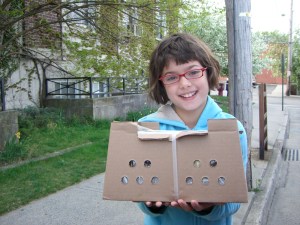
“Look, Mama!”

Pamela proudly hoisted a ventilated basket brimful of eggs.  In their pre-washed state, some of them were streaked with dirt (oh, right, dirt) but that made them look all the fresher.  She had passed the First Test of Poultry Ownership with flying colors– mostly varying shades of brown.

We were at Stone Barns Center on an extraordinarily mild late January day.  About a dozen children and their guardians ambled down the path from the upscale gift shop across the parking lots, beside the sprawling pastures and the greenhouses in their semi-dormant state.  It had been a ridiculously snowless winter compared to the polar onslaught of the previous year.  Plants had taken a nap, rather than a deep sleep, and by the time the Pennsylvania groundhog would announce his bizarre six more weeks of winter prediction, we were all saying, what winter, sure, why not?

The folks at Stone Barns are incredibly nice, especially our guide for this special program, Hands on the Farm Egg Collecting.  She clearly enjoyed her work and patiently answered our city folk questions.  At the end, even though you don’t get to keep the eggs, we clearly got our money’s worth.  After all, it’s not every Saturday you get to meet actual chickens.  And they give us so much– from soup to nuggets!

PJ took to egg gathering like…well, you know…but not all the children found the experience pleasurable.  Some, just like my mom when she was a little girl, found it downright terrifying.  And me?  Well, in the interests of not exposing my allergies to the special aroma of a hen house (there were hundreds of birds…free-range, organic, local, whatever—they were stinky!) so I declined to enter the egg gathering shed.  Pamela, qualmless, skipped in without me.  As I watched the other kids, dutifully lined up with basket and parent in tow, I fleetingly considered whether I was too chicken to raise birds.  Naaaaa.  I’m a bird-lover from way back, rescuer of hummingbirds, feeder of chickadees, even doing FeederWatch duty for Cornell’s program back in pre-Internet days.

Then, as I reminisced about my avian experiences, I  heard girlish sobs from the henhouse—my heart paused.  Not Pamela?!  Two younger girls and their distraught mother emerged in a cloud of feathers, as if wrapping up a quick pillow fight.  Not Pamela.  Several minutes later, the rest of the coterie came out, sans drama, all toting their tokens of animal husbandry.  I gave PJ a “good job” and she grinned.  It’s official.  We were ready for our six ducks and whatever eggs they cared to lay.

Let’s call your grandmom and tell her all about it.

Copyright 2012, Lori Fontanes
Starting at the Top (of the Pecking Order)

If you want information on housing chickens, backyard or otherwise, a simple web search turns up quite a bit.  Where to buy a coop, what to feed ‘em and when, what to do if they’re broody, moody or just a bit odd.  Acquiring an actual set-up just for ducks or attempting to build the same, prepare to dig deeper.  After several hours of confounding on-line research, I ordered Holderread’s classic tome, “Raising Ducks” then rather waiting for the mail to come, I kept browsing.  Maybe I could find someone in the poultry community who could help.

Clicking around, I came up with the idea of taking my daughter to Stone Barns Center, the agri-chic model farm in nearby Pocantico Hills, NY where we could pay $14 for the fun of plucking eggs from under a bunch of chicken butts.  (That’s $14 for both of us, btw.)  If the name rings a bell, maybe it’s because that’s where First Lady Michelle Obama made her now-famous announcement launching her campaign against childhood obesity.  Like I said, why not start at the top?

Although we had already ordered our birds, we were well within the cancellation period so I thought it might be a good idea to see how well Pamela and poultry actually performed.  Overkill?  Perhaps.  But I’m a part of the generation that had to go to a local hospital to have someone show me how to diaper a baby (don’t laugh—the classes, in Westside L.A., were packed.)  So the way my mind works, Want an Egg?  Find an Expert! (Thought I was gonna to say, Eggspert, weren’t you? Ha!)  Living in suburbia, I figured I had a choice: drive a few painful hours to/from Brooklyn or hop on the 287 to a town in idyllic lower Westchester a mere 30 minutes by freeway….ok, it’s official.  I’m a suburbanite! (sigh)

Copyright 2012, Lori Fontanes

Why Ducks, Not Chickens

Call me contrarian but since it seems like every other Brooklynite or Oaklander has backyard chickens, we wanted a different kind of egg-layer*.  Don’t get me wrong, I have nothing against chickens (or our friends in Oakland and NYC!)  When well-kept and not living among a few thousand of their closest pecking order, they are handsome and cheerful.  (I mean, the chickens, not our peeps.  I mean…oh, forget it.)   The choice of duck over chicken came down to these three things: 1) we personally witnessed the growth and development of someone else’s bunch down the street, 2) ducks are reputedly more weather-hardy and less prone to illness and disease and 3) my mother got scared by a chicken as a small child.

Actually, it was a bunch of chickens that freaked my mom.  And she was really little, say 3 or 4.  This was once upon a time when people of average means raised their own Sunday dinners out the back.  My grandparents had a piece of land in Georgia where the Atlanta airport now lives and they liked their food fresh (apparently!)  The tale as I remember it is that my mother kept begging her mother to let her feed the chickens since everyone else got to feed the chickens except her.  Now if you know anything about hungry chickens, you can easily imagine what happened when that little girl walked into the coop carrying a bucket of feed….

So after hearing this semi-scary story at a seminal moment in my own childhood, it stuck.  I didn’t want to invest all this time in a project that might make kids skittish, possibly even my own kid.  As it turned out, I need not have worried.

*We also (briefly) considered guinea hens—mostly for their tick-hunting prowess and because they’re so darn cute.  But my Lancaster County-bred nephew took me aside and said, Lori, you don’t want guineas.  Apparently they are not nearly as biddable as ducks or even chickens.


Copyright 2012, Lori Fontanes

March 20, 2012 First Day of Spring

We ordered the ducklings in January and told my husband after the fact.  He had gone from plain old no to you’re crazy ending up at does she really want ducks and it only took two years to get him there.  She is our 10-year-old daughter, Pamela– the bright, complicated, tornado of generosity who will be the putative caretaker of the waterfowl.  I am her enthusiastic but only slightly more experienced (in food-raising) mother.  We live in old school, train-adjacent suburbia in Westchester County, New York.  We just bought six ducks.*  Yikes!

* To be precise, we ordered six future ducks on January 26, 2012 with an expected ship date of April 16, 2012.  At that point, they were not only not ducks, they were not even eggs!


Copyright 2012, Lori Fontanes